

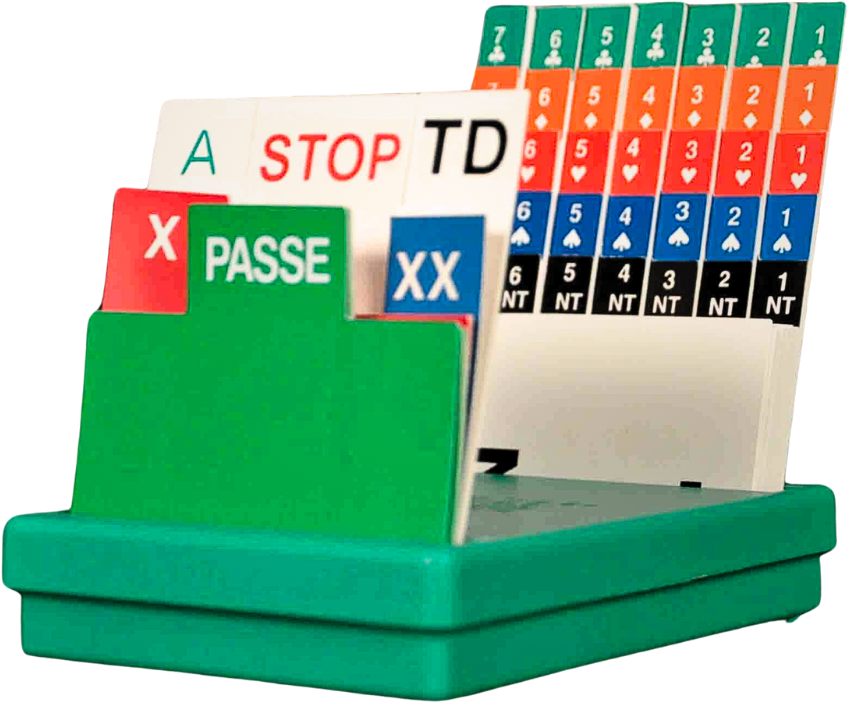
Signaling is more a playing technique than a rule. The software plays and interprets all the conventions and signals presented here. The subject is too broad to be summarized in just a few lines. All conventions, from the simplest to the most complex, are automatically alerted by the software as the auction proceeds. In addition, explanations are provided, which is very useful for beginners but also for advanced players, who can keep improving indefinitely. Here are the most common conventions:
five-card major, 1NT 15-17 HCP, 2NT 20-21 HCP, 2♦ game forcing, 2♣ semi-forcing, weak 2♥ and 2♠, Stayman, Blackwood 30-41, Cue-bid, Relay, Texas major and minor, Landy, Splinter, Roudi, Truscott, Lebensohl, Puppet, Gambling 3NT, Michael.
* strict odd-even
* fourth-best lead in notrump contracts
* classic top of sequence
* encouragement with high cards and discouragement with low cards, whatever the nature of the contract
* on discards too, direct suit preference signal
As a priority, lead your partner’s suit or honor sequences such as AKQ or KQJ, etc. In a trump contract: lead from a SINGLETON (a suit in which you hold only one card) other than trumps.
When playing with dummy: count your tricks suit by suit. Establish suits if you are short of tricks.
To establish a suit, you can:
* play your high cards in the suit to knock out the opponents’ honors,
* try a finesse, that is, attempt to win a trick with an honor on a one-in-two chance,
* ruff that suit in dummy. The ABC of defense: return partner’s suit, encourage with a high card if you like the suit, or discourage with a low one.